
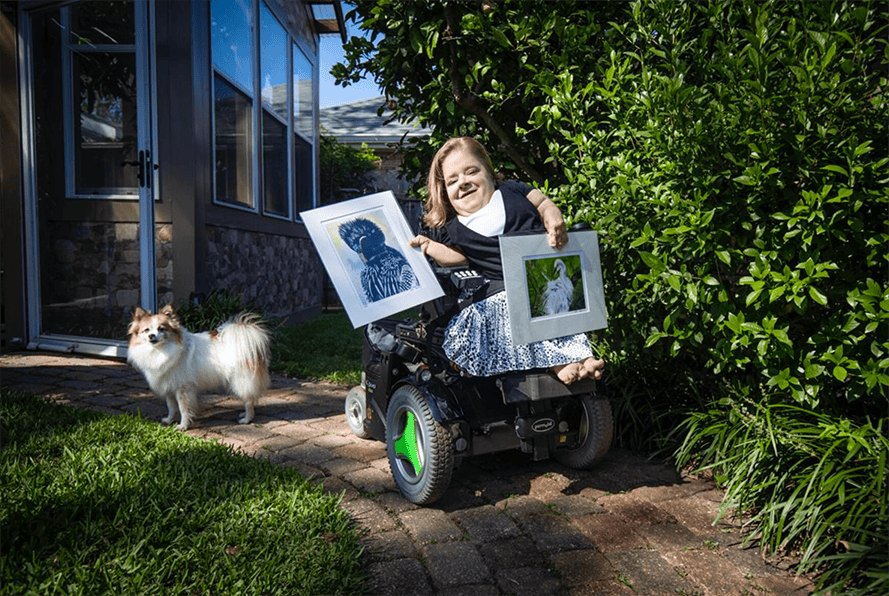
Being visibly disabled means I get to enjoy a very special privilege that most adults don’t experience: complete strangers saying absolutely ridiculous things to me in public.
Usually, they mean well.
That does not make it less weird.
I’m 37 years old. I own a business. I’m an artist and graphic designer. I have clients, deadlines, employees, and plenty of bills. I pay my employees out of my own pocket. My business is not government-assisted. I have opinions, responsibilities, a social life, and all the other things that come with being a grown woman.
And yet, apparently, the sight of a very small woman in a wheelchair causes some people to completely forget how they normally speak to adults.
So, in no particular order, here are some of my favorites.
“Isn’t she precious?”
This one is especially fun because it’s usually said about me while I am sitting right there.
Not “Hi, how are you?”
Not “I love your shirt.”
Just turning to whoever happens to be with me and announcing, “Isn’t she precious?”
Yes. She can also hear you.
Which brings me to another strange phenomenon…
Talking to My Aides Instead of Me
This happens all the time.
Someone has a question about me, so naturally, they turn to the person standing next to me.
“What would she like?”
“Does she need anything?”
“Can she…?”
Hello.
She is right here.
My aides help me physically. They are not my translators, spokespeople, legal guardians, or press secretaries.
If you have a question for me, there is a revolutionary new technique you can try:
Ask me.
“Do you have a license to drive that?”
No. I stole it.
There was a high-speed wheelchair chase. You probably missed it on the news.
I’ve been using a power wheelchair for most of my life. I promise I have this under control.
“Slow down or I’ll give you a speeding ticket!”
If I had a dollar for every time someone made this joke, I could probably afford a much faster wheelchair.
And then we’d really have a problem.
“You’re like a doll.”
I understand where this comes from. I’m 2’7″. I’m small. People aren’t used to seeing an adult my size.
But dolls are generally not 37-year-old business owners with employees, deadlines, and bills.
Also, most dolls don’t talk back.
I do.
“Look at how cute!”
Again: adult woman.
You can think my outfit is cute. You can think my hair is cute. You can even think I’m cute.
But there is a particular tone people use when they say this about me.
You know the one.
The same voice people use when a toddler walks into a room wearing tiny rain boots.
“Oh, That Poor Baby.”
This one might be my favorite simply because of how spectacularly wrong it is.
First, not a baby.
Second, probably not poor.
Third, I was most likely having a perfectly lovely day until a stranger started mourning my existence in the middle of the mall.
“What a Miracle.”
This one always leaves me wondering exactly what the miracle is.
That I’m alive?
That I’m at Target?
That I successfully made it through the produce section?
I have Osteogenesis Imperfecta. My life may look very different from yours, but existing in public is not an inspirational achievement.
Sometimes I am literally just buying shampoo.
Which leads us to…
“You’re Such an Inspiration!”
Sometimes I hear this after someone sees my artwork or hears my story, and I understand what they mean.
But sometimes?
I’m literally just existing.
I’m at a restaurant. I’m shopping. I’m going to an event. I have apparently inspired someone by successfully leaving my house.
I appreciate the kindness behind it, but disability doesn’t automatically make everything I do inspirational.
If you see me painting with a tiny brush for 15 hours and want to be impressed, go for it.
If I’m sitting in the checkout line at CVS buying toothpaste, maybe we can hold the applause.
“Your Talent Is a God-Given Gift.”
This one is complicated.
Do I believe I have natural artistic ability? Absolutely. And I understand that when someone calls my talent a gift, they mean it as a huge compliment.
But there’s something that gets lost when people attribute all of it to a gift I was simply handed.
I’ve worked really, really hard.
I’ve been painting for decades. I’ve spent countless hours practicing. I’ve made terrible paintings. I’ve learned techniques. I’ve experimented. I’ve studied. I’ve painted subjects over and over until I got them right.
The work I create today didn’t happen overnight.
Maybe talent gives you a starting point.
But skill takes work.
And I’d like a little credit for that part, too.
“Can I Hitch a Ride?”
Sure.
Hop on.
Let’s see how this works out for both of us.
“I Wish I Had One of Those!”
This is usually said by someone who is tired of walking.
And I understand the joke.
But no. You probably don’t.
A wheelchair is freedom for me. It gives me independence and mobility, and I’m incredibly grateful for it.
But needing one comes with a whole collection of challenges you probably aren’t including in this particular fantasy.
You don’t want to need my wheelchair.
You want a chair.
Those are very different things.
“Be Careful! You’re Going to Roll Off!”
Because of the way my body works, sometimes I need to lie down when I’m out in public. Put me on a table, and suddenly everyone around me develops an intense concern that gravity is about to claim me.
People seem convinced that at any moment I’m going to just…roll off.
I have been living in this body for 37 years.
I promise, I know how tables work.
If I were routinely rolling off furniture, I feel like we would have addressed that problem by now.
Most People Really Do Mean Well
And that’s the weird part.
Most of these people aren’t trying to be cruel.
They’re trying to be funny. They’re trying to compliment me. They’re curious. They’re uncomfortable. They don’t know what to say. Sometimes they’re genuinely trying to connect with me.
I know that.
But good intentions don’t automatically make something appropriate.
There’s a difference between acknowledging someone’s disability and reducing someone to it.
There’s a difference between being friendly and being patronizing.
There’s a difference between being impressed by something I’ve accomplished and being impressed that I exist.
And there’s a huge difference between talking to a disabled adult and talking about her to the person standing next to her.
You don’t have to pretend my wheelchair isn’t there. You don’t have to nervously avoid looking at me. And you definitely don’t have to come up with something profound to say.
Just talk to me like you would anyone else.
Say hello.
Ask how my day is going.
Compliment my fabulous outfit.
Ask me about my artwork.
Talk to me instead of the person standing next to me.
And if you’re about to ask whether I have a license to drive my wheelchair?
Just know that I’ve heard it before.
Probably several times that week.