
Another day, another reminder of why disability inclusion matters.
I have spent my entire life navigating a world that wasn’t exactly designed for someone like me. At 2’7″, with Osteogenesis Imperfecta Type III, I use an electric wheelchair and have some pretty significant physical limitations. But I’ve also spent 37 years figuring out how to do things differently.
I’m pretty good at problem-solving. I’ve had to be.
What I still haven’t figured out is why some people completely lose their minds when they encounter someone who looks or moves differently than they do.
And Monday was a perfect example.
It Started With a Job Opportunity
I was recently offered an opportunity to teach regular painting classes for adults and children through Jefferson Parish. Pretty exciting, right? After working through the logistics and figuring out how to make everything work financially, we were finally moving forward.
Of course, getting hired means paperwork. Lots of paperwork. And one of the requirements was a background check, complete with fingerprinting.
Simple enough.
Or so I thought.
I scheduled my appointment for Monday at 11:30 a.m. at a location on Airline Highway. My employee, Kaylie, came with me to help.
We arrived at a rather dingy office building, squeezed into a tiny, somewhat terrifying elevator, and made our way to the second floor.
The woman handling the fingerprinting arrived around the same time we did. She seemed perfectly pleasant at first and invited us into the office.
Then things got interesting.
“Oh, You Can’t Be in Here.”
When we entered the fingerprinting room, the woman looked at Kaylie, looked at me, and immediately told me I couldn’t be there.
“Why not?” I asked.
“Well, I’m doing her, and you can’t be in here.”
I explained that Kaylie wasn’t the one getting fingerprinted.
I was.
Kaylee was my employee, and she was there to assist me.
“Oh. Oh, well, okay.”
This is something that happens to me constantly. People see my wheelchair, my size, and my physical differences and automatically assume the able-bodied person accompanying me must be the one in charge.
But whatever. We moved on.
She collected my driver’s license, Social Security card, and other information. Everything was going fine until we got to the actual fingerprinting.
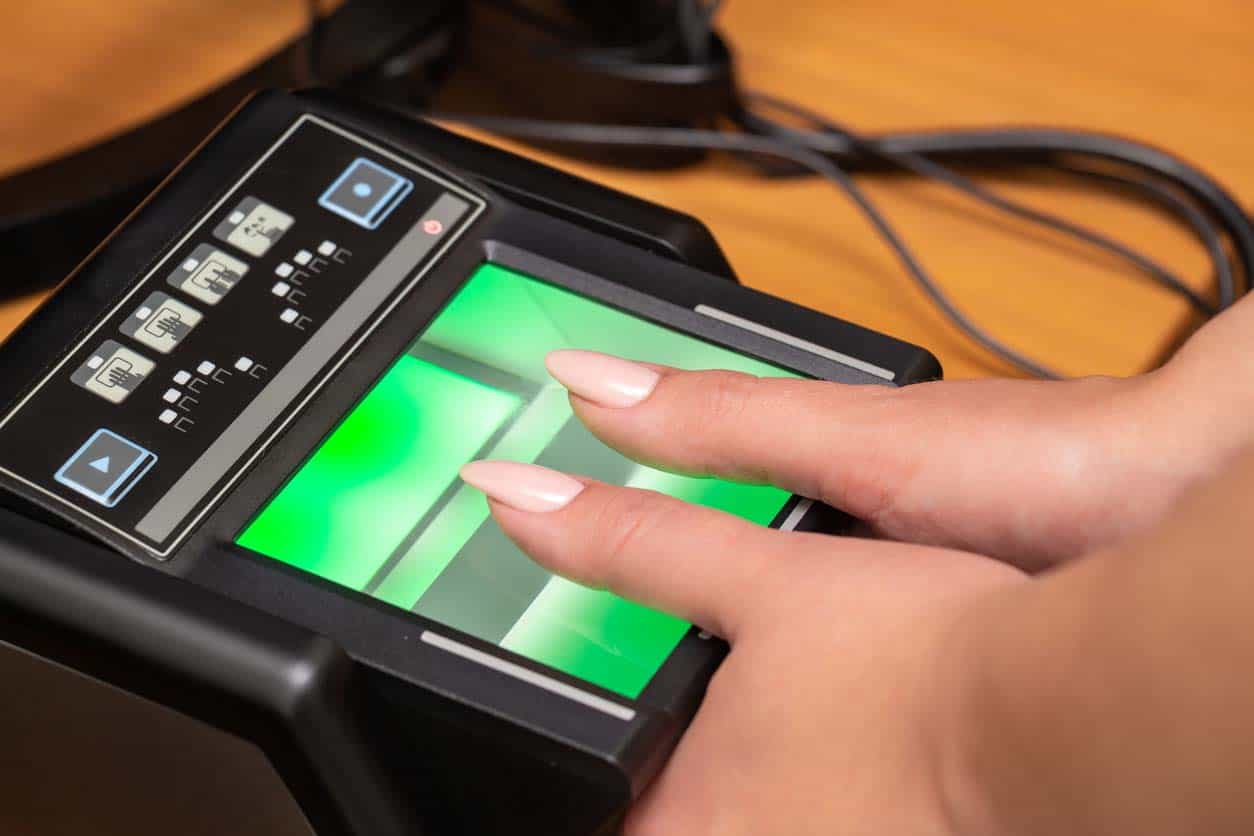
Modern fingerprinting machines use digital scanners instead of traditional ink. You place your thumbs together on a scanner, then scan each thumb individually, followed by your fingers.
Here’s the problem: The scanner was a large box, and I physically couldn’t position both of my hands on it the way the machine required.
Not because I wasn’t trying. Not because I was being difficult. My wrists simply do not move that way.
So I started doing what I’ve done my entire life.
Problem-solving.
Could I raise my wheelchair? Could we tilt the machine? Could we reposition it? Was there another way to get my hands where they needed to be?
I was perfectly willing to work through it.
The woman, however, was not.
“I Can’t Do This. I Can’t Do This.”
She started panicking.
And I mean PANICKING.
“I can’t do this. I can’t do this one. I’m not qualified for this. I just can’t. I can’t do this.”
Over and over again.
Meanwhile, I’m sitting there calmly trying to figure out how to get my fingerprints taken.
She finally announced that she needed to help another customer and call her supervisor. She sent Kaylie and me back to the waiting room.
Fine.
Except the waiting room was about 20 feet from the fingerprinting room, and she left the door open.
So we got to listen to her complain to the next customer about me.
How she couldn’t handle this. How she wasn’t qualified. How could anyone expect her to deal with something like this?
I could hear every word.
Let me be clear: I wasn’t upset that she didn’t immediately know how to accommodate my physical limitations. I don’t expect everyone to magically know what works for me.
What I do expect is for someone to treat me like a human being while we figure it out.
Apparently, that was asking a little too much.
“Look at It. This Is What I’m Working With.”
Then came the moment that really got me.
After finishing with the other customer, the woman called her supervisor and continued her frantic explanation about how she simply couldn’t handle my situation.
She wanted to show her supervisor what she was dealing with, so she attempted to start a video call.
She even needed Kaylie’s help answering the call.
Yes, my employee had to help the woman who was supposed to be helping me.
You can’t make this shit up.
Once the video was working, she turned the phone toward me and said:
“Look at it. This is what I’m working with. I can’t do this.”
Look. At. It.
Not “her.”
Not “this customer.”
“It.”
Now, I don’t know whether she was referring to me, my wheelchair, or the entire situation. But when you’re sitting there being displayed on a video call like some sort of unusual specimen, the distinction doesn’t feel particularly important.
I was absolutely floored.
I started explaining directly to the supervisor that I simply couldn’t position my arms the way the machine required. I wasn’t refusing to cooperate. I just needed another method.
The supervisor’s solution?
Go to the West Bank.
For those of you unfamiliar with the New Orleans area, that’s not exactly a quick trip from Metairie, especially with traffic.
But fine. Whatever it takes.
The Great Fingerprinting Tour of Jefferson Parish
By this point, we’d already wasted a good chunk of the day.
We had some other paperwork to drop off with Jefferson Parish, and when we explained what had happened, someone suggested trying the other East Bank fingerprinting locations before driving all the way to the West Bank.
Great idea!
Except the first location didn’t accept walk-ins.
And the second location was closed, despite employees being inside.
So, after driving around to multiple locations, we finally gave up and headed across the river to General de Gaulle.
All of this for fingerprints.
Finally, Someone Who Understood
When we arrived at the West Bank location, the experience was completely different.
The woman working there was friendly, patient, and willing to help.
We explained what had happened at the first location, and she immediately knew which employee we were talking about. Apparently, she had experienced her own difficulties working with that woman.
But here’s what made the biggest difference.
This woman had a sister with cerebral palsy.
She had personal experience with someone whose body worked differently from hers.
And instead of panicking, she simply started helping us figure things out.
Imagine that.
We repositioned the scanner. We tried different angles. We worked through the fingerprinting process together.
Unfortunately, the technology wasn’t nearly as cooperative.
Because of the time it took me to reposition my hands and fingers, the machine kept shutting down and making us start over.
We tried three or four times.
Eventually, she explained that I would probably need traditional ink fingerprinting instead.
Okay. No problem.
How do we do that?
Well, apparently only her supervisor could perform ink fingerprinting, and I would need to schedule another appointment.
And, of course, it could only be done on the West Bank.
So after an entire day of driving around Jefferson Parish, I still didn’t have my fingerprints taken.
I had, however, acquired a pretty good story.
This Is Why Inclusion Matters
Here’s the thing.
The first woman’s behavior wasn’t frustrating simply because she couldn’t figure out how to fingerprint me.
The second woman couldn’t figure it out either.
The difference was how they treated me.
One woman panicked, complained about me to another customer, made me feel like a problem, and seemed completely overwhelmed by the fact that my body didn’t work like hers.
The other woman treated me like a person, listened to me, and worked with me to find a solution.
Neither one successfully completed the fingerprinting.
But only one made me feel like I didn’t belong there.
And this is exactly why I am so passionate about disability inclusion, especially in schools. When children grow up around people with disabilities, they learn something incredibly important:
Different doesn’t mean scary. Different doesn’t mean incapable. And different certainly doesn’t mean someone deserves less respect.
If children regularly interact with classmates who use wheelchairs, communicate differently, need assistance, or have physical differences, those experiences become normal.
They learn to ask questions. They learn to adapt. They learn that a wheelchair is just a wheelchair, not some terrifying piece of equipment attached to a person they don’t know how to approach.
And hopefully, when those children become adults, they don’t completely fall apart when someone like me shows up for a background check.
I don’t need everyone to know exactly how to accommodate me.
I don’t need special treatment.
I don’t need anyone to panic, apologize profusely, or make a spectacle out of my disability.
I need people to talk to me, listen to me, and be willing to figure things out.
Because I can promise you, I’ve spent a whole lot more time figuring out how to live in a world designed for able-bodied people than most people have spent figuring out how to accommodate someone like me.
And I’m usually pretty darn good at it.
So, Did I Get My Background Check?
Not yet.
After multiple offices, a trip across the river, several failed fingerprint scans, and one very memorable video call, I’m still waiting to get ink fingerprinted.
Apparently, that’s going to require another appointment and another trip to the West Bank.
All so I can teach people how to paint.
The irony is that I regularly stand (figuratively, of course) in front of groups of children and adults talking about disability, inclusion, and finding creative ways to overcome obstacles.
And then I encounter a grown adult who can’t handle the sight of someone with a physical disability trying to get fingerprinted.
This is why I do what I do.
Because inclusion isn’t just about ramps, elevators, or accessible bathrooms.
It’s about attitudes.
It’s about exposure.
It’s about teaching people, from a young age, that human beings come in all shapes, sizes, and abilities.
And it’s about understanding that when something doesn’t work for someone, the appropriate response isn’t “I can’t deal with this.”
It’s “Let’s figure out another way.”
Now, if you’ll excuse me, I apparently have another fingerprinting adventure to schedule.